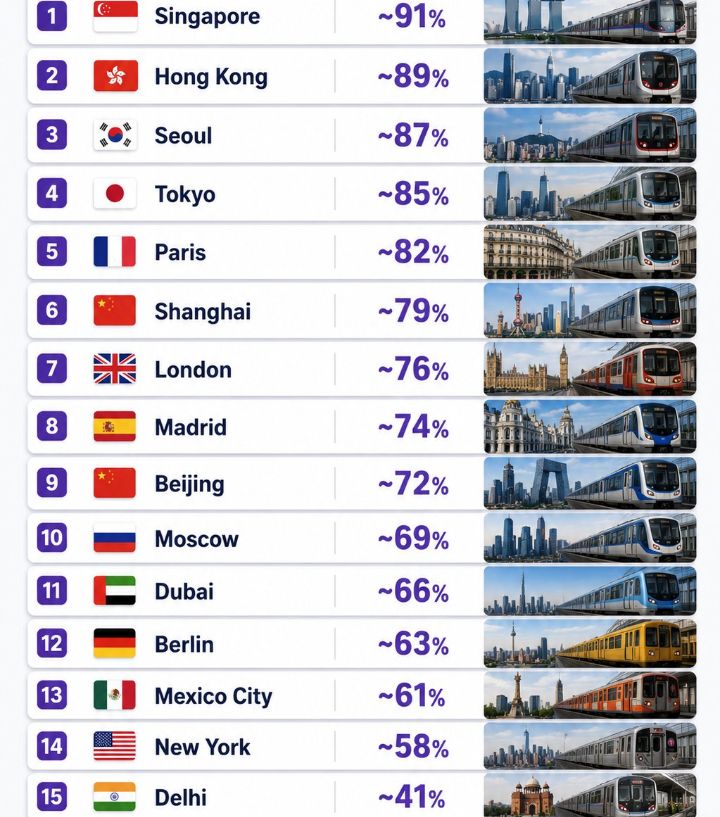
A new report by the Global Metro Accessibility Database has revealed the cities with the highest percentage of residents living within 500 meters of a metro station, highlighting the growing importance of efficient urban transportation systems. Singapore topped the global ranking with approximately 91 percent of residents living close to a metro station, followed closely by Hong Kong at 89 percent and Seoul at 87 percent. Experts say the strong performance of Asian cities reflects decades of investment in high-capacity public transportation infrastructure.
The report also ranked Tokyo and Paris among the world’s most accessible metro systems, with 85 percent and 82 percent coverage respectively. Chinese cities also featured prominently, with Shanghai recording 79 percent accessibility and Beijing reaching 72 percent. Analysts noted that rapid urbanization and population growth have pushed many governments to expand rail transport networks to reduce congestion and improve mobility.
European and Middle Eastern cities also secured strong positions in the ranking. London achieved 76 percent accessibility, while Madrid recorded 74 percent. Moscow and Dubai followed with 69 percent and 66 percent respectively. Meanwhile, Berlin, Mexico City, and New York also maintained significant metro accessibility rates.
The study concluded that cities with extensive metro coverage often experience reduced traffic congestion, shorter commuting times, and lower levels of air pollution. However, researchers stressed that maintaining affordable and efficient transit services remains a major challenge for rapidly growing urban centers. Delhi, which recorded 41 percent accessibility, was cited as an example of a city still expanding its transport infrastructure to meet rising demand from its growing population.